
My Black A.D.H.D

As a black woman who’s neurodivergent, nothing is ever acknowledged .
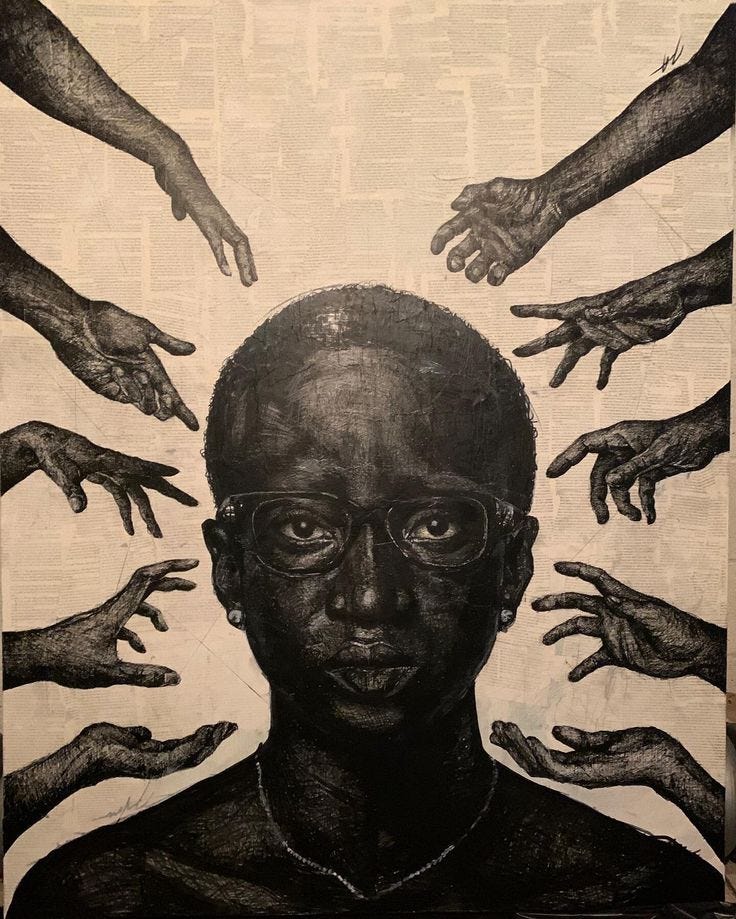
My ADHD manifested itself quite a long time ago, but no one ever knew what it was. Throughout my whole primary education, I received the same feedback: "She’s a great student; she just needs to concentrate!" , « She needs to put in a little more effort." Let’s also not fogrget the « Too much chattering » that often earned me bad looks . My parents, seeing my test papers filled with dumb little mistakes, mistakes that I could’ve avoided, mistakes that I knew were mistakes always said to me « "You need to focus! » Focus, focus, focus, the word « focus » haunted me.
As a Black woman, there are high expectations: you must do many things, know most things, and be nearly flawless. Slip-ups were not allowed, nor was forgetfulness. You should know how to conduct yourself, how to laugh in public, and be familiar with all social norms. But when I wasn’t really getting any of it, interrupting the important men around, forgetting what I’ve just been commanded or even losing every single jacket I’d be given, no one thought of ADHD. Instead, they labeled me disrespectful, rebellious, and ungrateful. No one ever stopped and thought that maybe it had something to do with my brain. Of course not, that would be acknowledging something was "wrong" with me, and in many African cultures, that translates to being "crazy." Therefore, I had to be irreproachable and obey.
To appear "normal" and sane, I had to find ways to somehow hide my disability while also being perfect at everything. I had to be first of my class, I had to be excell at any extracurricular activity and also manage the forgetting. That’s when I started memorizing and toruring myself at paying attention to anyone without zoning out. I trained myself to seem normal but of course I couldn’t escape my brain and got burnt out.
As a junior in high school, I had gone my entire life without a name for these symptoms.I thought it was anxiety mixed with laziness and a sprinkle of depression—a combination of the finer things in life. Then, a new friend of mine (one that was diagnosed) looked at me dead in the eyes and said; "You have ADHD, bitch."
That sentence changed the course of my life. For the first time, I knew I wasn’t crazy or dumb for not getting all the questions right; perhaps my dopamine levels were just a bit irregular.
I educated myself to ensure I wasn’t falsely diagnosing myself, and everything made sense then. All the time I spent thinking I was lazy when I was stuck in executive dysfunction, all the lost belongings not being a sign of carelessness etc, etc —it was amazing. After all these years i had also started doubting myself but now I understood. Then, came the moment to actually talk to my parents about my adhd. I mean, if I were medicated, my life would certainly look different, I’d be happier. What a shock to be met with a simple « That's impossible, you’re smart, you read books! » . They didn’t hear my explanation about the brain, neurons, and how having a disability didn’t make me weird or different. It was part of me, but I didn’t want it to consume me. Then, I faced yet another stereotype : "You’re okay; that is a white man’s disability, it’s fake." How could the person in front of me just discard years of professionl scientists work on the basis that it came from the West, therefore, I cannot have it. It was a bit funny, coming from the parent that probably passed me on this gene. Because, yes, adhd is mainly aqcuired if someone from your family has it. Studies show that Black individuals are less likely to be diagnosed with ADHD and more likely to be labeled with behavioral issues, perpetuating cycles of misdiagnosis and lack of support.
I am genuinly done with the misundersanding and stigmatisation. Those arguments are used and reused to diminish neurodivergent people, especially people with color. Yet we’re the same people that are expected to do so much and always surpass ourselves. We can’t be tired or even burnt out, we can’t be daydreamers, we can’t be different.
It’s a shame that mental health issues and neurodivergence can’t be freely discussed in Black homes. Sometimes, I wonder what our community would be like if we got the care we desperately need. Having adhd doesnt make me dysfonctional, it doesnt make me any less human either , and I need people - not just the old folks- to understand that it is okay to seek help when needed and that being black won’t protect you from getting those « white men diseases » as you call it. Let’s pave the way for future generations so that they can feel understood and get the care they deserve.
I love this!
The way you navigate the perspective of ADHD, with the additional context of the barriers as a black woman is truly exceptional and insightful.
The word focus still haunts me to this day, so when you mention that, it was highly relatable for me.
Conformity is something I’ve never been good with and systemic cycles are something I’m trying to break.
I said some questions below if you’re open to answering them, but by no means, are you obligated.
How was your experience with expectations, especially as a black woman, shaped who you are?
What are some ways you maintain dopamine levels today?
What would you like to see in the world that you don’t already see?
Thank you again for a truly insightful article. I really enjoyed reading it.